Product Description
Our technology
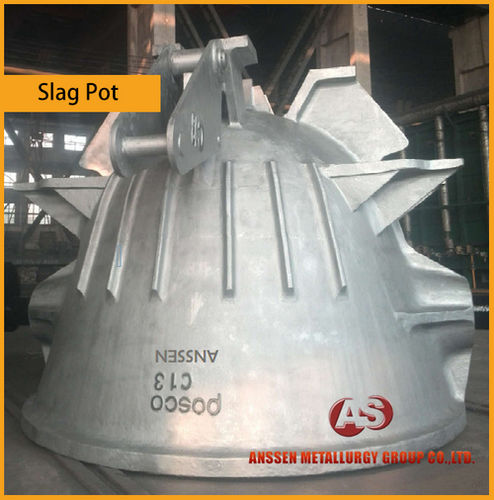
We adoptthickening the wall thickness of the slag pot at the rear to maintain center ofgravity balance after lifting the slag pot. So as to solve the hidden danger ofunstable center of gravity of the slag pot caused by the displacement of slagliquid.
We removedthe upper reinforcement side of the slag pot, and the bottom and middle upperparts of the slag pot became uniformly thinner. There were expansion jointsleft on the bottom reinforcement side, and strong ribs were added to the bottomto solve the problem of cracking after applying thermal stress, which couldcause the bag to penetrate.
Collecting the slag generated during the smelting process is beneficial for separating harmful impurities from useful components, reducing the environmental pollution caused by the enterprise. Secondly, by safely cooling and discharging slag, the safety hazards of high-temperature slag to production equipment and personnel can be reduced. The deslagging effect of the slag tank improves the reuse rate of waste resources and reduces the operating costs of enterprises.
Engineered for Extreme ConditionsDesigned to withstand temperatures up to 1600C, our slag pots are crafted with materials like ductile iron, cast iron, or alloy steel. Their robust construction efficiently resists thermal fatigue and minimizes cracking and deformation, ensuring excellent performance even in intense metallurgical environments.
Customizable Design OptionsFrom wall thickness to lifting lugs and lids, every aspect of these slag pots is customizable according to your operational needs and client requirements. This flexibility guarantees compatibility with a broad range of high-temperature slag handling systems in steel plants and foundries.
Effortless Handling and Minimal MaintenanceBuilt with heavy-duty lifting lugs and a sturdy structure, our slag pots are easily transportable by crane or dedicated transporters. Their polished or shot-blasted finish and solid design sharply reduce maintenance needs, saving time and costs over the equipments long service life.
FAQs of Slag Pot:
Q: How are these slag pots installed and transported within industrial facilities?
A: Our slag pots are designed with integrated lifting lugs, allowing for secure and efficient movement using cranes or specialized transporters. This enables quick relocation and installation tailored to your on-site requirements.
Q: What materials are used in the manufacturing of slag pots, and how does this benefit my operations?
A: Slag pots are made from ductile iron, cast iron, or alloy steelmaterials chosen for their superior strength, resistance to thermal fatigue, and longevity. These qualities ensure reliable performance and extended service life, even under extreme temperatures.
Q: Can the wall thickness and design features be customized?
A: Yes, every slag pot can be customized based on your operational needs, including wall thickness, the presence of lids, and lifting lug specifications. We also produce units based on customer drawings or requirements for seamless integration.
Q: What casting processes are employed, and how do they affect product quality?
A: We utilize both sand casting and metal mold casting techniques, which offer precise dimensional accuracy and robust structural integrity. This advances the slag pots durability and resistance to cracking or deformation over time.
Q: In which industries and applications are these slag pots most commonly used?
A: Our slag pots serve metallurgical industries, steel plants, foundries, and facilities requiring high-temperature slag transportation. Their adaptable design and impressive load capacity make them suitable across a range of heavy-duty applications.
Q: How often is maintenance required for these slag pots?
A: Thanks to the high-quality materials and robust construction, maintenance requirements are minimal. The design reduces the likelihood of cracking or deformation, supporting reliable, long-term operation.
Q: What are the main advantages of choosing these slag pots for slag handling?
A: Key benefits include exceptional temperature resistance, customizable features, minimal maintenance, and a long operational lifespan. These attributes ensure safe, efficient slag handling while delivering superior cost-effectiveness for industrial users.

 Send Inquiry



 Send Inquiry